


… referred to as “Water Keys” by more polite folks.

Let’s get that one out of the way right now. It is true that the vast majority of the liquid that comes out of those things is water. It was just moisture in your breath before it condensed on the cooler (probably room temperature, not body temperature) brass pipe that is your Trumpet. Eventually those tiny droplets accumulate into bigger droplets that gurgle around in your instrument until you release them. BUT … if it came through your mouth on its way to the Trumpet it might have picked up the odd bit of saliva, lunch or just bad breath along the way. There’s nothing bacteria like better than a warm, damp environment in which to multiply like maggots on dead fish (see I’se the B’y). So, while most of what comes out of your “water key” is just water, it’s probably tainted with a little spit, a few chunks of unswallowed food and a little valve oil. I wouldn’t drink “water” with that ingredient list so let’s just call it what it is – a spit valve. SPIT, SPIT, Spitty McSpitterson. They’re spit valves.
The gentle folk who are calling them “water keys” are usually trying to sell you something – like a “classy” Trumpet, trying to impress you with their dignified vocabulary or they just can’t deal with the fact that something so crass could come out of such a beautiful instrument. Even the tiniest bit of potential saliva would offend you if it was floating around in your otherwise pure glass of water. Treat it like spit. Spit spit spit!


Spit valves come in different shapes and sizes but all with the same purpose – to get that gurgling stuff out of your Trumpet. Most spit valves are either the old fashioned lever action cup with a cork (or rubber) pad or an Amado style that Ray Amado invented in the 1960’s. Trumpet makers play around with these two styles but there’s not much else out there. (Something called JoyKey is showing up in the French Horn world and looks interesting for the future.) If you look closely at the black rubber seal above (in place of a cork) you’ll see that it has a little nipple that goes right up into well that surrounds the hole in the Trumpet’s tubing. The idea is to minimize any turbulence created by that hole. It’s a less radical solution to the same problem that Ray Amado was solving. That rubber “cork” is on a Yamaha Piccolo Trumpet. The Amado above is on my old Bach Bb – I had it changed out back in the late 70’s when Lou Ranger told me to. … something about turbulence.
There are some bad spit valve knock-offs lurking on the internet but there are also a couple of gems. There’s a new thing called Orbit Water Keys that looks space age and seems to be well-made. My friend Vince Mai had them put on his “FrankenTrumpet” and he loves them. He’s been around a long time and uses his horns hard, so I trust him. Harrelson Trumpets also has an improved Amado-style water key that is meant to be more dependable than the 60’s invention
Most Trumpets have two spit valves – one on the main tuning slide and one on the 3rd valve slide*. Emptying the main one simply requires holding it open and blowing gently through the instrument. To empty the third valve slide spit valve you’ll need to hold down the 3rd valve with one hand and open that spit valve with the other before you blow gently through the horn. This brings up a few items: when to empty these valves; where to put the “water” that comes out and what I mean by “gently”.
Let’s start with “gently”. Every now and then I get into a school band room where brass players think they have to make some kind of rude honking sound when they dump their spit. Corporal punishment has gone out of fashion since I was a kid, so maybe that’s why they’re getting away with it. I don’t know. If you blow too hard you’re just going to blow the water past the opening that’s trying to let it out. As a bonus you’re contributing to the impending madness of your band teacher. Emptying your spit won’t likely be totally silent, but it doesn’t have to be noisy.
The best time to empty your spit valves is before you hear that gurgling sound that tells you you’re late. There are some obvious factors that affect how often this is like how much moist air you’re putting through the Trumpet and how cold the Trumpet is. The greater the difference between your body temperature and the temperature of the brass, the faster condensation is going to accumulate.
I played an outdoor brass quintet concert during a heat wave and every time I went to empty out nothing happened. That was at the height of Covid-19 and we had been asked to bring towels and remove them in Ziploc bags etc. There was a lot of concern about “the spit” that didn’t materialize. Another outdoor brass gig was at a ski resort in December and eventually we were shut down by freezing spit. We’d go inside for a bit and thaw out then play until things froze up. The problem was worse for us because the difference in temperature between our lungs and the tubing was extreme. More condensation meant more freezing water. That’s life on a brass instrument.
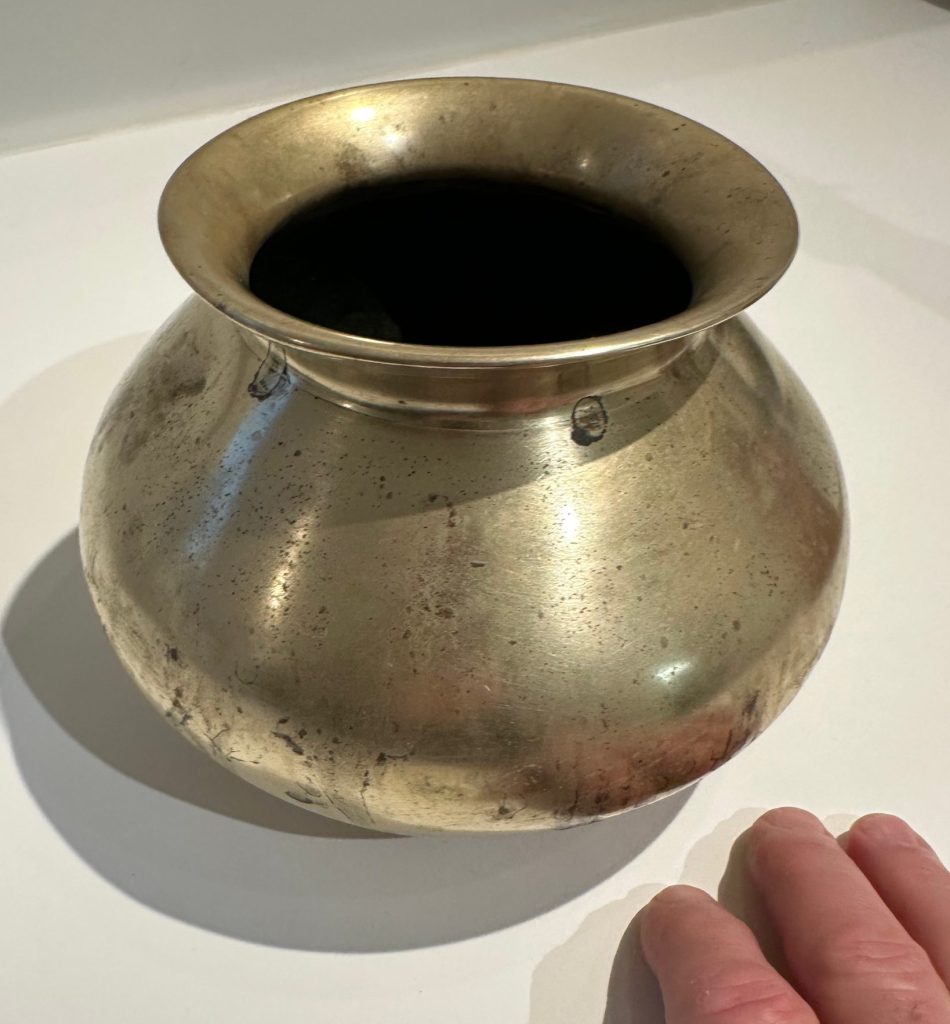
As for where to empty your spit that really depends on where you are. If you have a place where you always practice you should come up with a plan. Paper towel, an old newspaper, a rag, a real towel, a tuna can or nothing – I’ve used all of them. We moved several years ago and I needed a new solution so I found an old brass spittoon at a junk shop. That’s my solution at home but I think it might be on the extreme end of the solution spectrum. It remains surprisingly clean because one day’s water evaporates before the next. At the other end of the spectrum is just letting it fall wherever and that’s generally what I use at gigs unless there’s something unusual (like a Persian rug or a worldwide pandemic).
Don’t expect everyone to be spit-friendly. If you’re sharing your playing environment with someone who is really grossed-out you’ll have to think about the real price of letting your “water” loose. It isn’t that difficult to do something about it – or not.
*If your Trumpet doesn’t have a spit valve on the 3rd valve slide welcome to the club … my main Bb Trumpet doesn’t have one either. You’ll have to yank that slide out and dump it occasionally. If you’re lucky there’ll be a small extension on the end of the slide that you can pull without taking the while thing off – like this:

If there’s no extension you’ll have to pull the entire 3rd slide as I do on my C Trumpet:
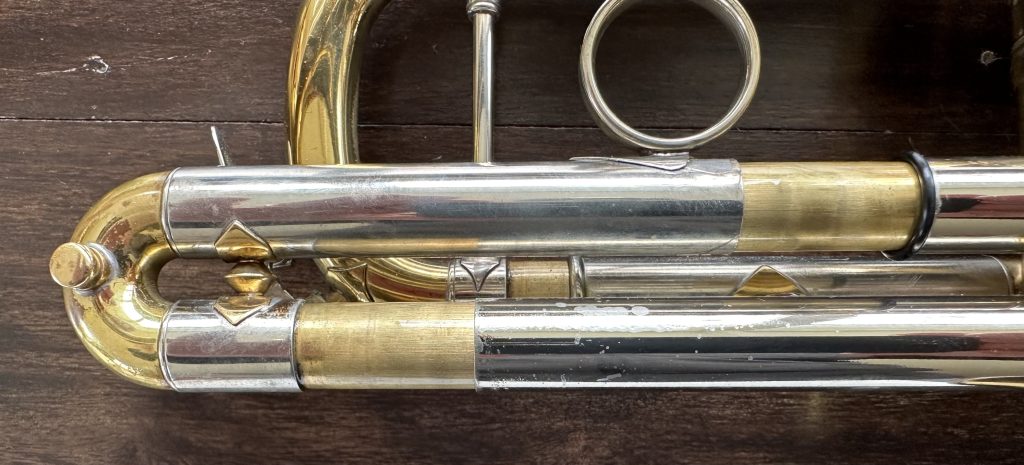
If removing the 3rd slide is a production (as it is with yet another old Trumpet I use occasionally) you’ll have to figure out how to let it flow downhill – valve pressed – until it ends up coming out the bell, the leadpipe or the main spit valve. You’ll look a bit like a French Horn player twirling the instrument around. You’ll figure it out – it’s gravity and water likes to run downhill.
One more thing: Sometimes you try to get the gurgle out and find that the spit valves aren’t doing the whole job. Assuming that they’re not plugged up you should look in the first and second valve slides for the culprit. Some Trumpets just have a way of trapping enough droplets in their first or second valves or valve slides to cause the dreaded gurgle (not to be confused with The Dreaded Lurgy). The first attack is to pull and dump the offending slide(s). If that doesn’t complete the task then pull the offending slide and blow air through the Trumpet with its valve down. That usually does the trick, and it can work with the French Horn strategy above. I have one ornery old Trumpet that needs that treatment regularly.
There are some maintenance issues around spit valves that I’ll address soon in another post over in the Trumpet Maintenance area of this blog.
Leave a Reply